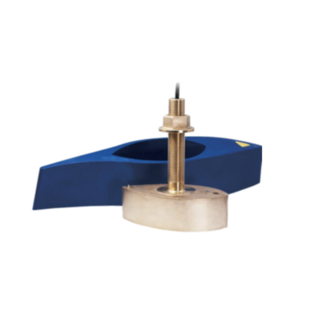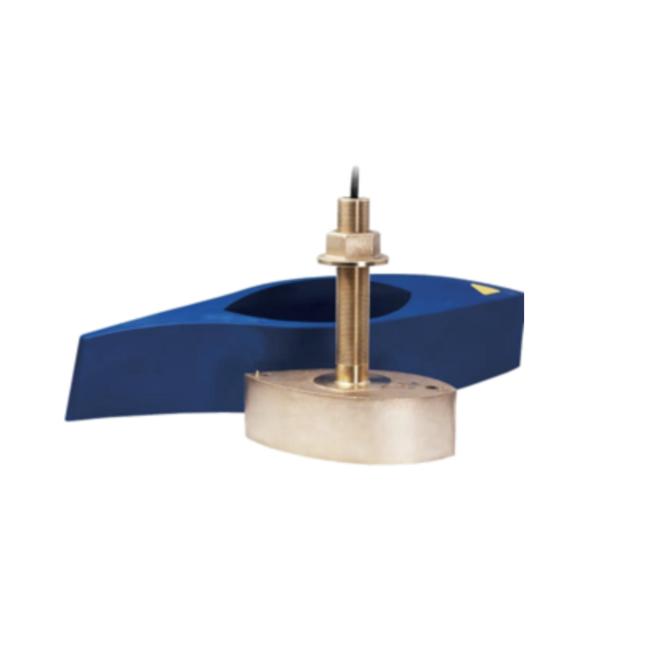


Airmar B265LH 1 kW dual-band CHIRP bronze thru-hull transducer with fairing, 42–65 & 130–210 kHz. Provides deep-water penetration, sharp HF detail, reliable target separation and fast depth/temperature sensing. Includes 9 m cable. Read more.
The AIRMAR B265LH is a high-performance dual-band CHIRP thru-hull transducer, designed for exceptional deep-water reach and precise high-frequency resolution across the full Low–High CHIRP spectrum. Many species respond best to specific frequencies—Bluefin tuna around 60 kHz, squid around 133 kHz, cod around 175 kHz—and the B265LH covers all of these plus every value in both CHIRP bands. With its powerful 1 kW output, it delivers excellent bottom discrimination, clear separation of bait and game fish and clean water-column visibility at all depths.
Airmar’s design includes a seven-element low-frequency array operating from 42–65 kHz, enabling strong broadband penetration to 914 m (3000 ft). The high-frequency ceramic runs from 130–210 kHz with a narrow 10°–6° beam, ideal for isolating targets tight to structure and resolving fine detail in shallow and mid-water. The transducer features a bronze housing and a high-performance fairing, which stabilises the acoustic flow and significantly improves high-speed performance, particularly above 30 knots. Depth and fast-response temperature sensing are fully integrated, and wiring is provided as bare wire for fishfinder-specific termination.
The B265LH features a low-profile bronze thru-hull design that provides correct acoustic alignment in the water without the need to select a specific tilt-angle version. This simplifies product selection while delivering accurate depth readings and consistent dual-channel CHIRP performance.
Dual-band CHIRP (42–65 & 130–210 kHz): Broader LF penetration plus tight HF detail.
1 kW output: Strong deep-water performance and clear broadband returns.
Seven-element LF array: Reliable coverage to 914 m (3000 ft).
Narrow HF beam (10°–6°): Ideal for structure fishing and target isolation.
Covers 50 kHz & 200 kHz: Traditional points included within CHIRP bandwidth.
High-performance fairing: Ensures clean flow and enhanced performance over 30 knots.
Bronze housing: Durable, corrosion-resistant and acoustically efficient.
Depth & temperature sensors: Integrated fast-response measurement.
Bare-wire connection: For OEM or Mix-and-Match configuration.
Urethane acoustic window: Stable long-term performance in water.
B265LH Transducer Body
Dual-band CHIRP ceramic assembly enclosed in a bronze thru-hull housing, with integrated depth and temperature sensors.
High-Performance Fairing Block
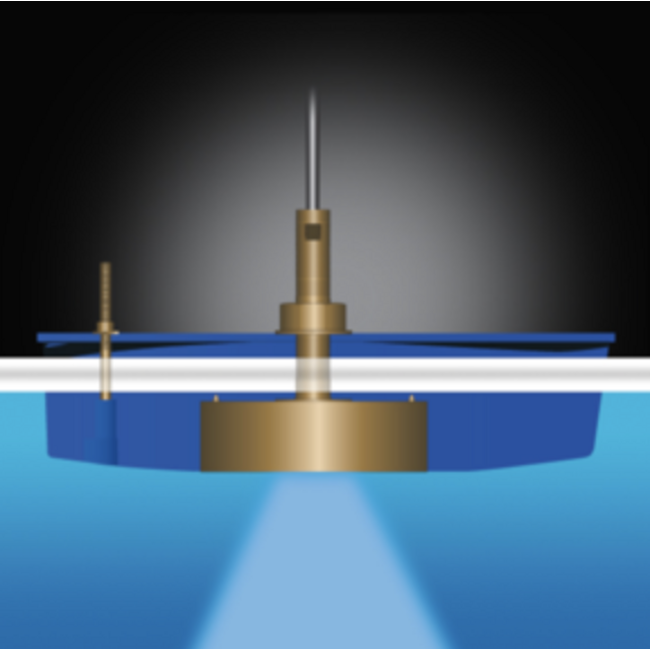
Hydrodynamic fairing that aligns the transducer, minimises turbulence and improves acoustic stability at speed.
Wiring Harness (Bare Wire Output)
12-m cable supplied without connector for direct termination or for use with Mix & Match adapter cables.
Power: 1 kW
Low Frequency: 42–65 kHz, 25°–16° beamwidth
High Frequency: 130–210 kHz, 10°–6° beamwidth
Max depth: LF: 914 m / 3000 ft; HF: 304 m / 1000 ft
Functions: Depth, temperature
Housing: Bronze with urethane acoustic window
Mounting: Thru-hull with fairing
Cable length: 12 m
Connector: Bare wire (no display connector)
Max deadrise: Up to 20° with fairing
Compatible hulls: Fiberglass or wood
Max vessel LOA: 8 m (25 ft) and above
Weight: 7.3 kg (16 lb)
Hole size: 30 mm
Usable shaft length: 121 mm
Technology: Xducer ID®
Design: Non-tilted, non-retractable
Supported systems: Furuno CHIRP sounders and TZtouch platforms using bare-wire or Mix & Match adapters.
Supported functions: Depth and temperature.
Options available: Also produced as TM265LH, PM265LH, CM265LH and M265LH for alternative mounting styles.
B265LH 1 kW Low–High CHIRP bronze thru-hull transducer
High-performance fairing block and mounting hardware
12 m bare-wire cable
Installation documentation
Install the transducer through the hull using the fairing to ensure proper alignment, optimal beam angle and clean water flow. Position the unit forward of steps, strakes and turbulence-producing features. Maintain full underwater immersion at all running speeds. Route the cable through a watertight gland and connect via the appropriate termination or Mix & Match adapter, keeping wiring isolated from electrical interference for maximum CHIRP performance.
The low-profile thru-hull housing is installed flush with the hull to ensure proper acoustic alignment in the water. Correct positioning during installation is essential for accurate depth readings and reliable dual-channel CHIRP performance.

 FURUNO